I watched Napoleon, Ridley Scott’s newest grand historical epic, this last weekend and, well, okay, it’s not that bad. I liked the epic scale of it, one can’t deny the technical mastery on display, the acting was fine, and I’m sure there are a lot of details I could have appreciated had I been in a more generous viewing mindset.
But I wasn’t. Because the movie sucked.

To be clear, the movie doesn’t suck enough to warrant a hot take. It’s Yet Another Disappointing Big Budget Movie that goes big on spectacle and small on, well, everything else, and the only rational response to it is to shrug, try to remember the utter marvel that underpins the fact that we get to live in a modern world where such an elaborate production and effort can elicit no more than a ‘meh’ from our jaded souls, and move on to the next thing. But something about this movie is just not letting me go, and I’m bothered enough by it that I need to write it out.
Napoleon (the movie) made the mistake of focusing on the titular character’s ego rather than on the complex circumstances that swept a lowborn outsider up to the heights of power that had hitherto been the sole domain of the aristocratic elite. It’s important to take the wind out of the hero worship of tyrants, sure, and Napoleon is one of history’s mass murderers and deserves to be knocked off the pedestal some put him up on, but seeing Napoleon blunder from embarrassment to embarrassment is not an entertaining movie.
Like, yeah, the big name guy at the top of the hierarchy is cool and all, but what about all those guys dying in the battle scenes?! Why in the world would they let Joaquin Phoenix (as Napoleon) talk them into walking onto those battlefields in the first place? Portraying Napoleon’s rise as farcical, while providing no additional context nor any other real characters beyond Napoleon himself, makes everyone else in the movie—from extras with no dialogue to those rare other characters that get to say anything in this film—look like just as big of clowns.
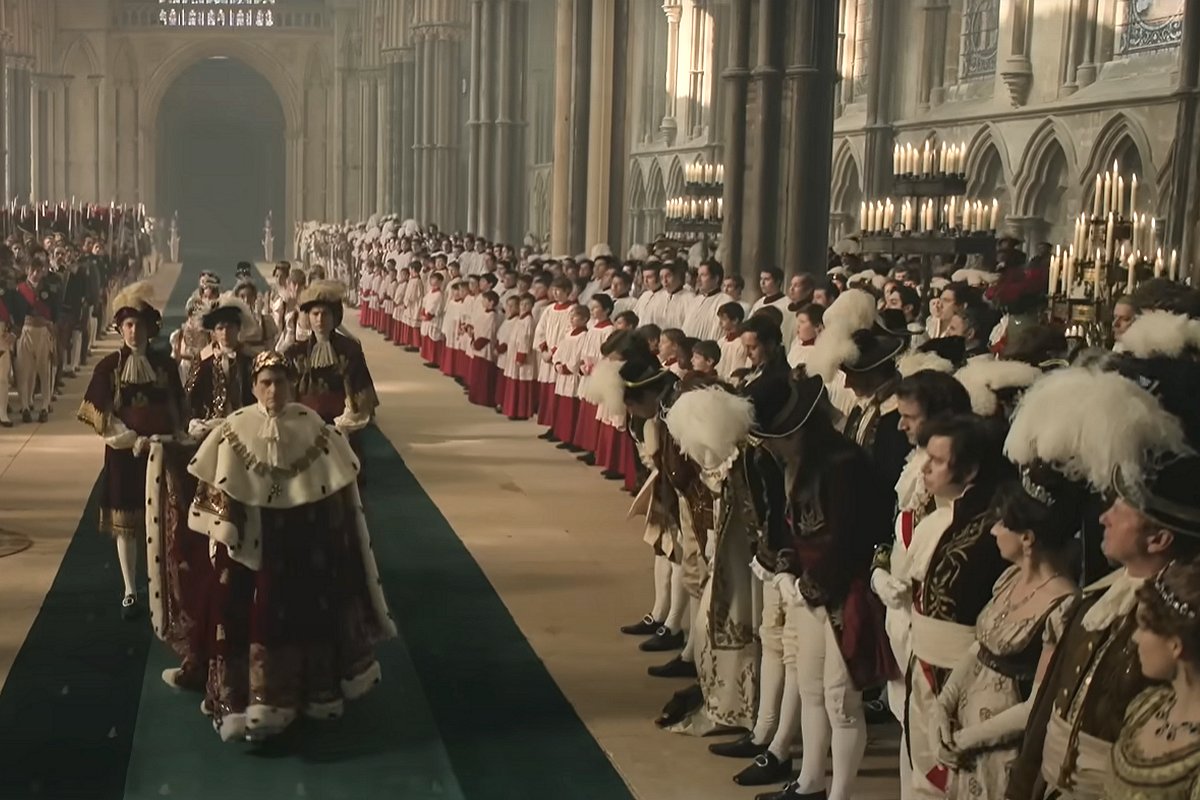
Hollywood History is Fantasy
Look, I get it. Hollywood is not the place to turn to for in depth examinations of historical events. I’m not watching Ridley Scott’s movies because I want to understand the complex relationship between 2nd century CE gladiators and the Roman public, I’m watching Gladiator because it’s an interesting fantasy world to imagine. I like most of Scott’s historical (fantasy) epics, and I went into Napoleon expecting spectacle and ready to enjoy the historical inaccuracies (it’s fun to learn what is close to reality and what is pure Hollywood) and thin-on-context portrayal of events. The bar wasn’t set that high! But the movie refused to just walk up and meet that bar and instead did some weird limbo shimmy right on under it, which left me searching, in the unsatisfying glow of its credits, for what had left me so irritated.
It wasn’t the viewing experience. Like I said, the movie sucks, but not enough to get worked up about. It was, rather, the entire premise of the movie itself. You know, that little ol’ thing. Namely, it was the movie’s choice to focus so tightly on the ego of Napoleon that has me muttering and typing away in my little corner of the interweb here, because—and let me bold this—the absurdity of the ego of the tyrant fucking everyone over is the least interesting part of a tyrant fucking everyone over.
I kind of want to type that again, I feel so strongly about it.
Instead, let me take a half-step back and frame this a little more coherently. Napoleon (the movie) is tightly focused on its titular character, to the exclusion of basically every other character besides his lover Joséphine de Beauharnais (played by Vanessa Kirby), and that’s a perfectly okay choice for a movie to make. The movie also paints a pretty unsympathetic portrayal of Napoleon, highlighting his grandiose self-opinion and eliding over any suggestion of brilliance or genius, which, again, is a perfectly okay choice for a movie to make. I think there’s an interesting discussion to be had about what kind of person Napoleon actually was and whether he deserves his reputation as a genius or not, and a movie taking the position that the man was pretty much a clown is one I’m showing up to watch. So far, so good, right?
There’s no real moment where the movie goes off rails that I can point to as the moment that lost me, either. Somewhere around the Battle of Austerlitz I was feeling pretty thoroughly unimpressed with the film, but still couldn’t figure out why. By this point in the movie it’s clear Ridley Scott’s tale is unapologetically taking shots at Napoleon, painting him as a self-deluded little man (a position reinforced by the end of the movie, with Napoleon expositing that he has never made a mistake in his life and his exile is the fault of his inferior lessers) while Joaquin Phoenix does his considerable best to give us a human, rather than caricatured, performance (for which he deserves praise). This is, I believe, all the movie is really aiming to show; there’s really nothing else to it beyond saying Napoleon is a(n emotionally) small man.
Ridley Scott’s take on Napoleon, everyone.
Upon reflection, I realized this is exactly why I don’t like the movie.
It’s not because I disagree with that conclusion. Like I said, there’s definitely a discussion to be had there, and I’m here for it. I dislike the movie’s portrayal of Napoleon to the exclusion of the wider historical context because I dislike what it says about everyone else who lived through those times. Or, worse, what it says about everyone else who did not survive that upheaval.
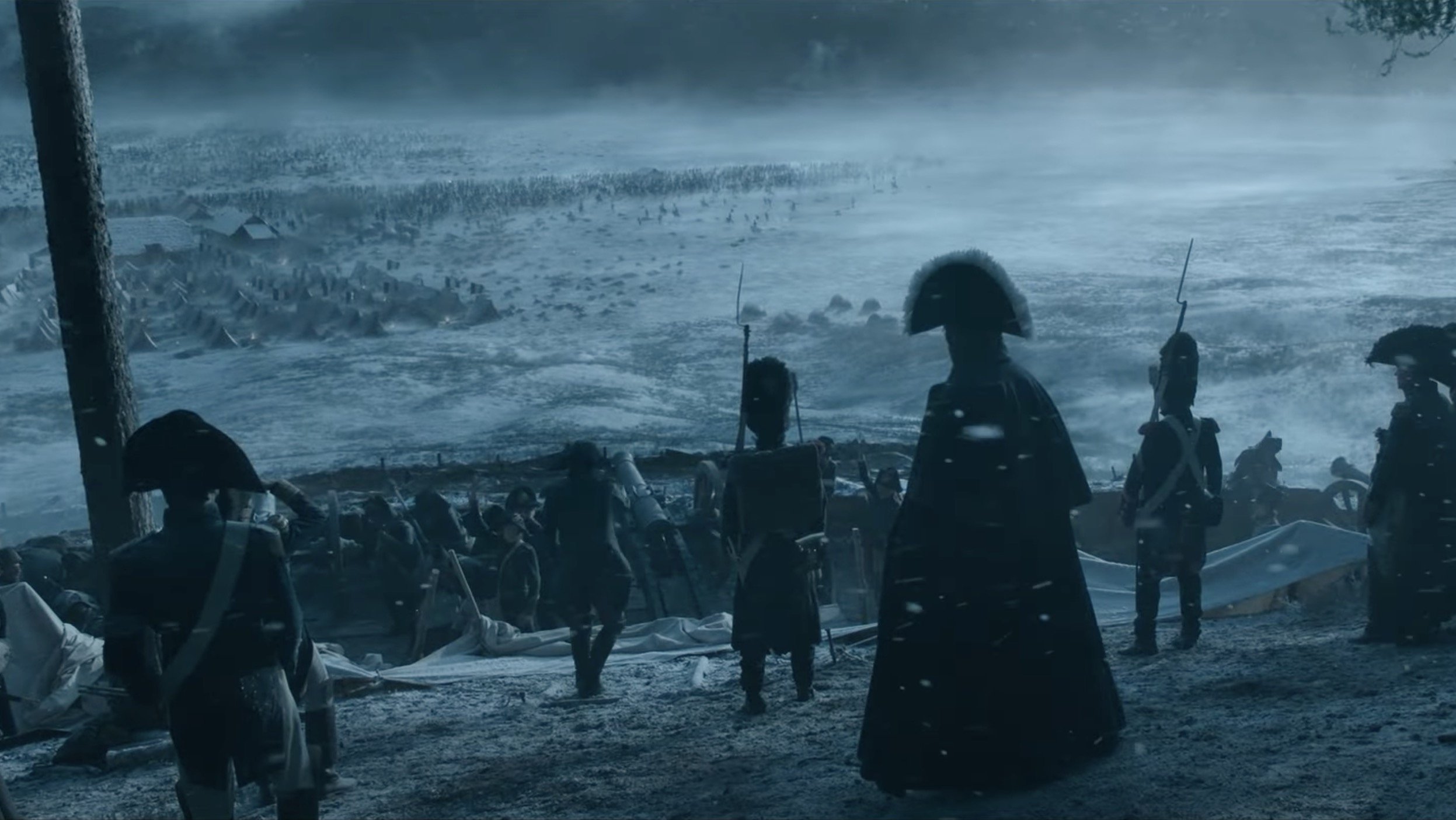
People Are Not Stupid
As easy as it is to reach for the explanation that people are idiots, it just isn’t true. I don’t even think we ought to give credence to the popular notion that while individuals might be intelligent, crowds are stupid.
I don’t think the early 19th century population of France was dumb.
So why did Napoleon’s soldiers follow him? Why was he able to crown himself emperor of a nation that had just put their nobles under the guillotine? The movie is telling us a tale of a buffoon, one who is reeling from embarrassment to embarrassment, but never once do we see any pushback from any other character.
There it is. In a sentence, that’s why I don’t like the movie. If Napoleon is such a small man,why did the people of France revere him?!
Seriously. Everyone leaps to obey this clown. Near the end of the movie, when Napoleon escapes his first exile in Elba and returns to France and begins marching on Paris, he is faced with a line of Royalist soldiers who are sent to stop him. Yet, rather than shoot him dead and end the farce, they end up cheering him and joining with him to start the grand ol’ cycle of murderin’ and dyin’ all over again.
Why?
It’s irresponsible of a movie not to address this question, and I don’t mean that it’s irresponsible to the history, I mean it’s irresponsible to the fiction. It’s bad storytelling. It’s a poor fiction. Can you imagine a fantasy novel with a story revolving around a buffoon of a tyrant that never once bothers to show why people do as they order? I know I would give up on it quickly.

What’s The Takeaway, Then?
I think the real answer why so many followed Napoleon—in its absolute most simplified, stripped down version—is because the many people on the lowest rungs of society collectively decided they would rather kill and die than continue to be exploited by the few people on the highest rungs and they saw Napoleon as a means to redress that wrong. Right or wrong, many felt that the poor had to pay taxes and the rich didn’t, and Napoleon’s use of violence was the only way to restore balance to the scales.
It’s hard not to wonder whether Ridley Scott intended this movie to be a timely commentary on current events within the U.S. and the wider western world. If so, it doesn’t say anything well enough about its own fiction, and there’s nothing in it worth extrapolating out into our lived reality.
The movie ends with a list of casualties from the many battles portrayed within it, an estimate of just how many human beings with rich and complex inner lives were killed during the Napoleonic Wars. The movie’s estimate of three million deaths is conservative (or else is only counting military casualties), and possibly more than six million souls perished in those conflicts. Why did so many lose their lives? The movie seems to give the answers that it was all to sate the vanity of a clown—but never bothers to search for what that clown was peddling to the masses, nor why he was so successful at selling it.
 Rustworks
Leave a comment